Cultivation theory - the repetition of images, stories etc begins to shape our beliefs.
Wednesday, 14 November 2018

Tuesday, 13 November 2018
Front pages analysis
.
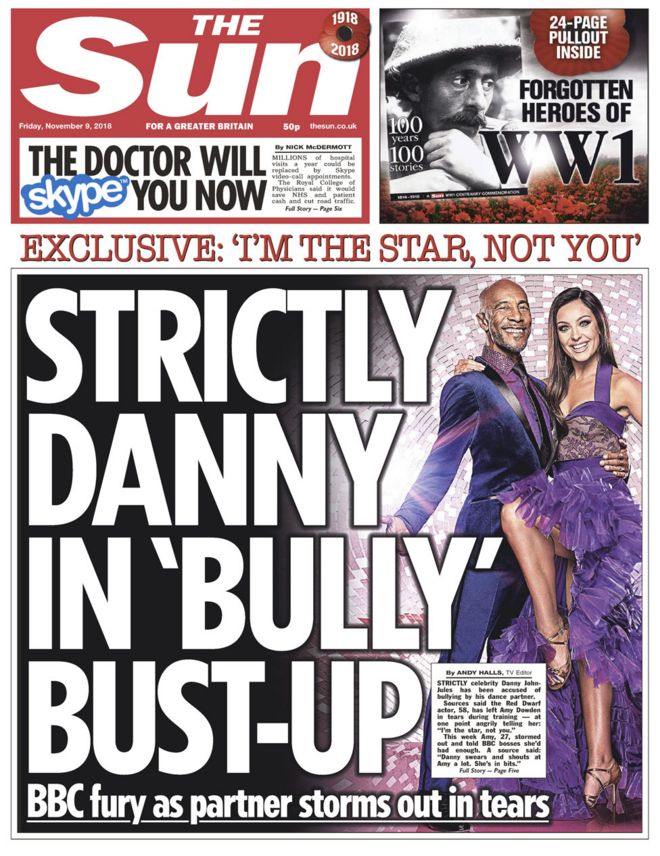
This is The Sun front page from today (9/11/18), and the main story is to do with celebrities and, more specifically Strictly Come Dancing, despite there being other important events happening in the world today. For example, yesterday there was a wildfire in Florida.
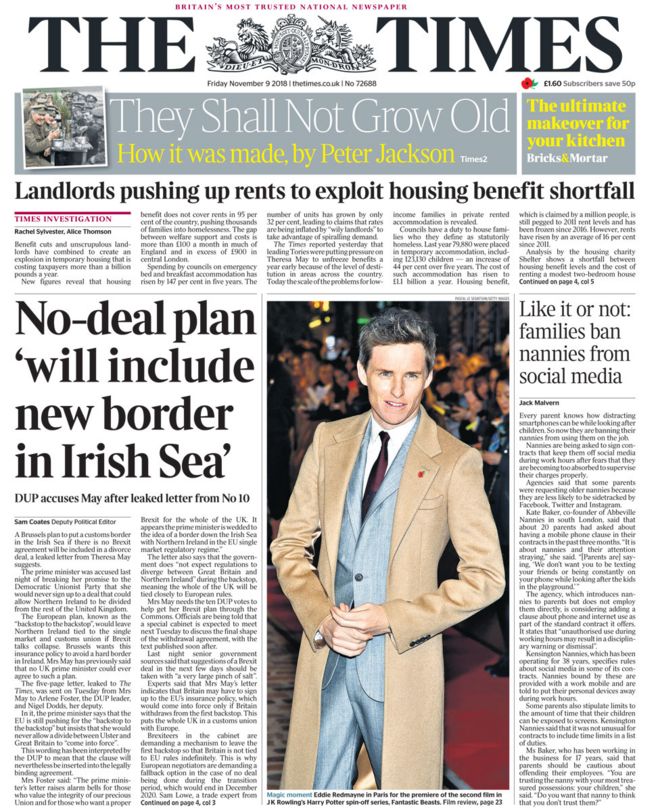
Broadsheet:
This is the Times from today (9/11/18), and the main story is about Brexit, and there are multiple stories on the front page, whereas there is only 1 or maybe two main stories, with a much larger picture and larger and bolder text. On the broadsheet, there is a lot more text with more detail, so is for a older target audience.

Mid-Market Tabloids:
The mid-market tabloids are similar to the normal tabloids as they often avoid front page news on politics, and prefer to show stories to do with celebrities or, with the Daily Express, the weather. The Daily Express has a reputation of a panic obsession with weather.
Monday, 12 November 2018
Today's Newspapers screen recording
In this video you see the broadsheet newspapers first, which has more political than the tabloids, with a lot of news on Brexit, and the mid-term elections in the US. Then, moving on to the Tabloid papers, straight away we notice how the majority of the page is taken up by pictures, with the main topic being the viral video of people burning a Grenfell Tower model on a bonfire. As well as this, the other main topics are all to do with celebrities.
From the headlines and main stories of these newspapers, we can tell that the broadsheets are aimed at an older audience, due to the lack of pictures and amount of text there is.
Wednesday, 7 November 2018

Tuesday, 6 November 2018
Newspaper - Language
Tabloid vs Broadsheets
Broadsheets:
Broadsheets:
- politics
- more detail
- simple font
- 70% text, 30% images
- less colour
- aimed at more intelligent people
Tabloids:
- pictures
- celebrities
- less text
- larger text
- more colourful
- bold text
- capitals
- entertainment
- 80% images, 20% text
Monday, 5 November 2018
Industry notes
1980s - 50 companies owned 90% of the media
2011 - 6 companies
2015 - comcast highest revenue company - biggest cable provider - half the access to internet in the US.
Disney - £48 billion - ABC, ESPN, Pixar, Marvel, Lucasfilm.
21st century Fox - advertising - $800 million
Time Warner - lost $100 billion in 2002 when merged with AOL. 2004 they separated.
UK media:
3 companies control 71% of national newspaper circulation. The BBC is a public service broadcaster - doesn't rely on pleasing advertisers.
Theorists:
- Curran and Seaton - power in media industries.
- Livingstone and Lunt - regulation.
- Hesmondalgh - cultural industries.
Media convergence - when audiences use one platform to consume various types of media texts.
Media format - type of media e.g. video, print based.
Media platform - where media text is presented e.g. TV, cinema, magazine etc.
Marketing and promotion:
- celeb endorsement
- cross media campaigns
- market research
Audience Notes
Demographic Profiling:
A - higher management, bankers, lawyers, doctors etc.
B - middle management, teachers, creative and media people.
C1 - office supervisors, junior managements, nurses, white collar jobs, specialist clerical jobs.
A,B,C1 - target more expensive supermarkets and products.
Psychographic profiling:
Mainstreamers - largest group - security - live comfortably.
Aspirers - seek status. Younger people.
Succeeders - seek control - higher management and professionals.
Resigned - seek survival - older people.
Explorers - seeks discovery.
Strugglers - seeks escape - alienated and disorganised.
Reformers - seeks enlightenment.
Thursday, 1 November 2018
Advert Evaluation
The task we were given was to make a sweet advert for middle aged men. We tried to sell the product to that audience by showing that it would give men working in the city who are stressed during the day a boost of energy to make them stronger and feel more alive. The name of our brand was City Bears.
I worked with Joe Collins and Nathan. We each had equal roles in acting, camera work, planning and editing.
We planned our advert scene by scene, brainstorming ideas of how we wanted it to start and end the advert. This meant we could write down lots of ideas for each scene, and narrow it down to make sure the video came together well.
We researched different songs for parts of the advert to make sure we found the right song that fits the genre, we watched other adverts for inspiration and created a logo for our product.
I think that overall the advert went well, especially the choice of music and where we cut each scene, however we could have improved the advert by adding some more special effects to add to the feeling of strength that was shown in the video.
Friday, 19 October 2018
Subscribe to:
Posts (Atom)